Multilingual from birth
Five languages. One safety net.
Biteshot was built in English, Spanish, French, Hindi and Marathi from the first build, not translated at the end. Language is an input to every design decision, and safety never depends on which one you picked.
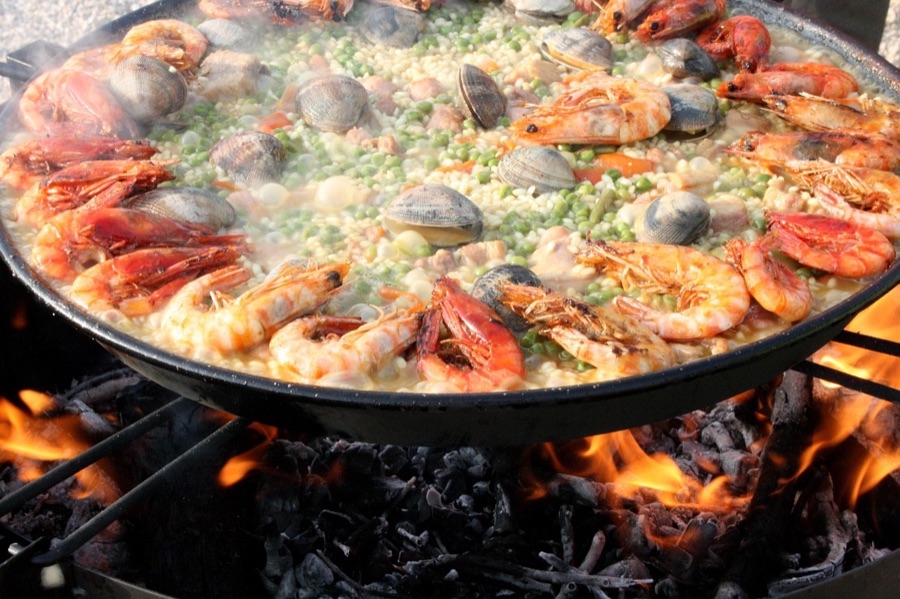
Most apps add languages last: export the strings, send them out, paste the answers back. It mostly works, and it fails in small, telling ways. A button cuts a word in half, a sentence glued from parts reads backwards, a dish gets a name nobody uses. A food app has a sharper version of the problem. Someone who cooks varan bhaat doesn't log "lentil stew", and an allergy check that only understands English is a safety bug, not a translation bug.
So we made five languages a first-class input from the start. This post is how that works end to end: the switch, the strings, the AI, the safety rules, the layout, the voices, the feed, and what broke along the way.
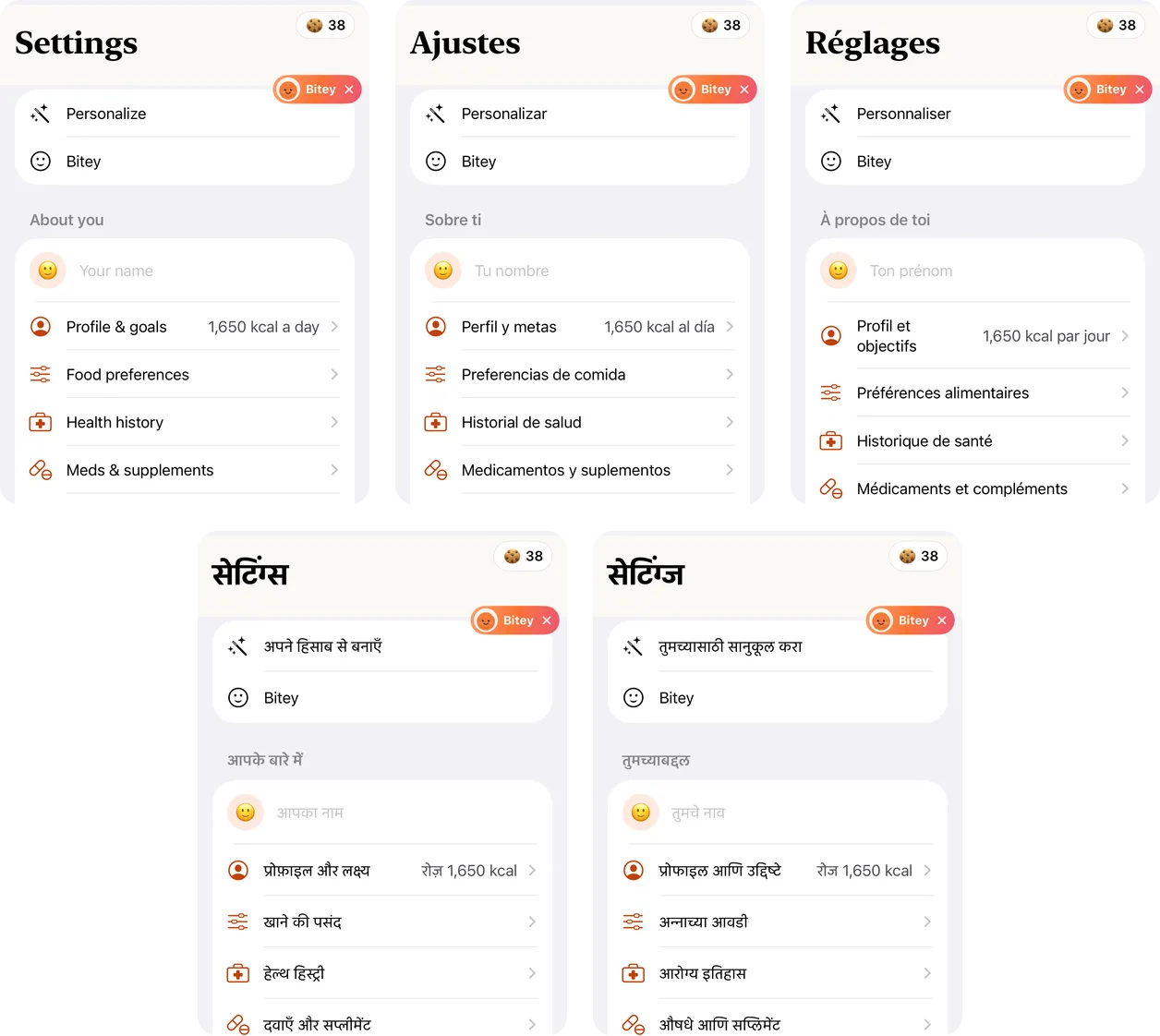
One switch, the whole app
You pick a language once, in the first step of onboarding (the companion greets you with "Hi! · ¡Hola! · Bonjour ! · नमस्ते! · नमस्कार!"), and can change it any time in Settings. It's your language in Biteshot, not your phone's: plenty of people run their phone in English and want to cook in Marathi.
- On iPhone, the app swaps the bundle it reads text from to the chosen language and rebuilds the screen tree with that locale. It applies instantly; no restart. Dates, weekday names and numbers follow the same locale.
- On Android, the same choice sets the app's own locale, so it holds even when the system language differs.
- On the server, every request carries the app's language in a header. It's put into a per-request context, so any code that writes text for you, deep in any call stack, knows the language without passing it around.
Before a choice is made, the app uses the phone's language when it's one of the five, and English otherwise.
One set of words, two phones
The iPhone app holds about 4,800 strings per language; Android about 4,100. Keeping ten files in step by hand would drift within a week, so they aren't kept by hand:
- English text is the key. Code says
"Delete post", notdelete_button_2. A missing translation falls back to readable English, never to a key. - Android is generated from the iPhone files. A script looks up each Android English string in the iPhone's English file and copies that key's translation from the other four, mapping placeholders in order (
%@becomes%s,%lldbecomes%d). Strings that only exist on Android get their own small translation files. Both phones show the same words, so a support answer in Hindi matches both screens. - No sentence is glued from parts. "3 meals left today" is one string with a number in it, because in other languages the number moves and the noun changes form. Plurals are real plural forms, not an "s".
- A feature isn't done until it reads well in all five. Every change that adds copy adds it in five languages on both phones in the same commit. The string counts per language match; when they don't, something was missed.
The AI speaks your language, safety reads English
Scans, meal plans, recipes, the fridge, Bitey's chat: anything an AI writes for you comes back in your language. That's one shared instruction, added to every prompt from the request's language: write every text meant for the person (dish names, notes, steps, tips, replies) in natural Marathi, in Devanagari script, but keep JSON keys, enum values, units and numbers exactly as specified, in English. The app's parsers never see a translated key.
The hard part is safety. Our allergen and diet rules match ingredient words against one shared keyword list (peanut, groundnut, satay, kung pao…), the same file on iPhone, Android and the server, with a shared test fixture so all three agree. That list has 302 keywords across 9 allergen groups, plus false-positive exceptions ("water chestnut" is not a tree nut), and every one of them is English. A keyword list in one language is blind in the others: "शेंगदाणे" is peanuts, and an English list will never know. We could have translated the list five times; we chose not to, because five lists drift and a missed word in one of them is an allergic reaction.
So every AI answer that contains a meal or recipe must also carry a hidden field, en: its name and every ingredient, including sauces, oils and toppings, in plain English. You read पोहे; the allergy check reads "poha, flattened rice, peanuts, curry leaves, mustard seeds, oil". Rules run on the English, the screen shows the Marathi. Food data stays English internally, so search and matching work across languages too.
Safety wording itself is never improvised by a model. Warnings, limits and "check the ingredients first" notes are fixed, translated strings.
When we can't read it, we fail closed
People write what they want. A Dig In post might be in Hindi under an English app, or mix scripts. Two rules keep that safe:
- A post is tagged by what it actually says. When most of the letters in a post are Devanagari under an English, Spanish or French app, it's tagged as Hindi; Latin letters are never retagged. (Hindi and Marathi share a script, so between those two the app's language wins.) The tag decides whose feed it reaches and when "Translate" is offered.
- Diet and allergy tags from your own words come only from English. A post in another language gets its tags from the AI check's English reading of it. Until those arrive, the post is marked "Ingredients still being checked" for anyone with a diet, allergy, pregnancy or gentle-mode filter, and it can't be saved or planned against an allergy. If the AI can't produce English names, it stays that way until a person adds them. A flagged post beats a peanut dish passing as peanut-free.
Search works the same way: accents are folded ("creme" finds "crème"), Devanagari is searched as written, and diet words in any of the five languages map to the same filter.
Layouts that bend
We measured every one of the 4,788 strings against its English original (strings of 12+ characters for the ratios):
| Language | Total length vs English | Median string | 90th percentile | Strings ≥ 1.5× English | UTF-8 bytes vs English |
|---|---|---|---|---|---|
| Spanish | +13% | 1.13× | 1.40× | 174 | 1.15× |
| French | +22% | 1.21× | 1.50× | 345 | 1.25× |
| Hindi | +5% | 1.03× | 1.30× | 82 | 2.54× |
| Marathi | +5% | 1.04× | 1.32× | 87 | 2.62× |
Two different problems hide in that table. French is the width problem: one string in ten is at least 1.5× its English, so any label sized for English will clip. Hindi and Marathi are the height and bytes problem: about the same number of characters, but Devanagari stacks marks above and below the line, and every character is three bytes in UTF-8, so anything with a byte limit (push notification payloads, database fields, AI output caps) fills up two and a half times faster. So:
- Nothing assumes a width. Buttons size to their text, rows wrap, and labels move under their values at large text sizes instead of truncating.
- We test at the largest accessibility text size, on both phones, through whole flows like onboarding, where every screen must still be reachable and readable.
- Tone is a decision. French speaks to you as tu, everywhere. Mixing tu and vous across screens reads like five different apps, and it's one of the first things a native speaker notices.
A voice in each language
Bitey speaks your language. The first thing Bitey asks, out loud, is which language you'd like, and from then on the app, Bitey's replies and Bitey's voice are all in it. You can pick Bitey's voice too: eight accents and styles, each recorded once per language and bundled with the app. That means no per-user cost, no network needed, and no waiting on a speech service when Bitey says welcome back. Listening uses the phone's own on-device recognition where it supports your language, and typing where it doesn't.
Dig In, in five languages
The feed is where language shows most. A few design choices:
- Personas are written natively, not translated. Each language has its own 25 AI food personas with their own cuisines and cities. A Marathi persona's post was written in Marathi from a Marathi brief. (How that kitchen works is in Real plates, AI personas.)
- Persona comments are assembled from parts, more than 230 distinct comments per language, with an anti-repeat rule, so they don't read like one canned line.
- Translate on demand, once. A post in another language offers Translate. The first request for a post and language is translated by AI and stored; everyone after gets the stored copy instantly, at no extra cost.
- The Library follows you. Videos and podcasts show in your language, and English fills in only when a topic has fewer than three in yours.
What broke (so far)
- The AI budget ran out in alphabetical order. The nightly post job has a fixed number of AI calls per night and walks the languages in a fixed order: English, Spanish, French, Hindi, Marathi. On quiet nights that was fine. From November 7 the plan grew, the budget didn't, and the run notes showed it plainly: English 39 AI-written posts, Spanish 38, French 13, Hindi 0, Marathi 0, three nights running. Nothing failed; Hindi and Marathi were filled entirely by template remakes of existing recipes, so the feed looked fine and no alert fired. The fix we're making: split the night's budget across languages up front instead of first come, first served, and alert on the AI-written share per language, not just on failures. Lesson: "no errors" isn't "fair".
- Photo libraries don't cook Indian food. Every persona post needs a real, checked photo. Free libraries have a thousand pictures of pasta and almost none of avial, pongal, keema pav or sev bhaji, so Hindi and Marathi posts were being held back for lack of a photo. On November 9 the English feed published 30 persona posts and the Marathi feed 10, mostly for this reason. The fix so far is better search terms per dish and broader fallbacks, never a generated image. It's still the thinnest part of the Marathi feed.
- A persona from another language opened blank. Following lists can include personas from other language feeds, and their profile page looked them up only in the current language. It now asks the server for that persona directly.
- Our own homepage, in one language. The website's language switcher missed one line of lead text, so in one language the "Get it on Google Play" button rendered as plain text. Languages need tests on the website too, not just in the apps.
- Plurals and placeholders between platforms. The first version of the sync script handled only simple strings; counts like "1 meal / 3 meals" needed real plural forms on Android. It does now.
The honest part: native review
Machine translation is very good now, and it lets a small team ship five languages at once. But a model doesn't know how your family says things. Our Hindi and Marathi still need a full native-speaker pass, and until that's done some phrases will sound stiff. If something reads wrong in your language, tell us in the comments or in the app, and we'll fix it fast.
What's next
Better recognition of regional dishes in photos, not just their names; more local dishes in the offline food data we're building next, so logging works without a connection in every language; and then more languages. Each new one will go through the same rules: the switch, one set of words, an English shadow for safety, and fail closed when we can't read it.
— Ani, founder of Biteshot
Comments
Loading comments…